Showing posts with label treatments. Show all posts

3.29.2015

Building Pre-Dressing Skills

One of the most obvious ADLs is dressing. And this is often an area that OTs may address in early intervention or school settings. If you're interested in building these skills for your child or a young client, read below for some of my favorite strategies.

Undressing- Before a child is able to dress themselves, they start to undress themselves. In a reverse chaining method, you can allow your child to do the last step of the undressing. This might be pushing pants off from ankles, or pushing a shirt over his head. Socks and shoes are also a favorite for kids to doff.

Play Dress Up - Dress up games serve double purpose- imaginary play and building physical skills. Some examples might be using different hats, or using the commercially available hooded towels or blankets to practice putting things on their head. I made a cape for my son out of an old t-shirt by cutting off the sleeves and front of the shirt.

Another piece in the dress up category would be gloves or booties that come in these kits with a coordinating book. A friend gave us the "Tickle Monster" book and my son loves donning and doffing the gloves.


Pullover bibs- These are such a simple way to practice the overhead movement. They don't catch as much as the ones with a big pocket, but depending on what you are serving they will be more than sufficient. I see these often at discount stores, but there are also a number of tutorials for how you can make your own.

Dolls- Practicing dressing and undressing dolls is a great way to build fine motor skills, use of fasteners (usually velcro) and address valuable social-emotional skills also.

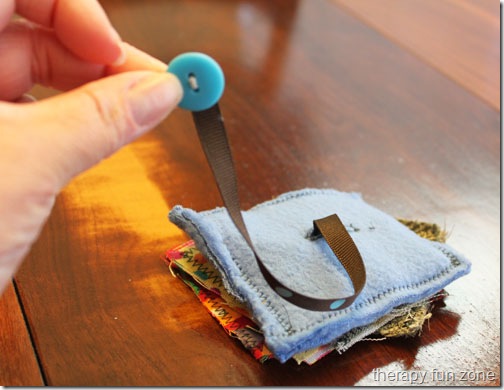
Button Snake- When it comes to practicing fastener skills, the button snake is becoming well known in therapy and mommy communities. I have made these out of scrap materials before because I'm cheap and don't want to spend a lot of time on it. Tonya at Therapy Fun Zone makes much nicer ones and also has ideas such as making a button sandwich out of felt pieces. 
button snake 1web
Image via Therapy Fun Zone

What are some of the ways that you use to build dressing skills?

12.05.2014

Using a Christmas Tree for Child Development

I am really in the Christmas spirit this year. Partly because I was looking for some happiness and positive energy after a bleak fall, and partly because this year my son can really start to enjoy the season. He pays attention to everything and has plenty of commentary about what's going on, so he was very excited when the first decorations went up (during his naptime) and asks everyday to turn the lights on.

For a little while, there were no ornaments on the tree. I didn't want my little climber to get any ideas and try to get up to the higher branches, and I know that there is no way to keep some ornaments intact around kids (they can come back in 10 years or so...). But I decided to make the tree a more interactive experience for him with minimal hassle from me.


Closer view of some soft ornaments
A couple ornaments for mom on top, most for the baby on the bottom.

I set out the ornaments that were soft and unbreakable. I took off all the wires that we normally use to hang ornaments. I made sure that all of them had a loop to hang by- some needed additional yarn to have a larger loop. The loops are varied lengths and materials which presents different challenges. I also made sure to put out a bucket and box so that my son had a location to put in and take out (a favorite toddler past time).


I really only showed him how to pinch and spread open the yarn loop to make it large enough to fit on a branch a handful of times, and that was enough to inspire hours of self-directed play. It's a very easy activity to set up, and from that we have an easy starting point for practicing communication and cognition concepts. We talk about the characters, what color they are, on/off, in/out, up/down - it's a very natural way to play with a child and promote development in multiple areas.

Here's some ideas for good ornaments for toddlers and preschoolers to use for their personal decorating:

- Pipe Cleaners / Beads: If you have a preschooler or an older sibling, there are plenty of ways to make inexpensive, unlikely to break, ornaments that you can treasure as kids' projects in years to come.
     - Easy bead and pipe cleaners
     - A variety of easy ornaments
     - Triangular beaded candy canes
     - lace and bead wreath
     - pipe cleaner wreath

- Plastic Canvas: One of my aunts just loved to do plastic canvas crafts. Some of these were designed to be magnets, but many were ornaments. Since they are all yarn, they are no worries about injury or ornament damage.
     - Pre-made from Etsy
     - Ornament patterns  1  2  3
   
- Clothespin ornaments: The pinching requirement to operate these is another great fine motor challenge, and it makes for a nice change of pace.
     - DIY Snowmen
     - Etsy set


While ceding my tree to my toddler seemed pretty logical to me, especially since I don't want to spend everyday telling him not to touch the most interesting thing in the room, my husband reminded me that it was my OT brain and not just a "common sense" thing. So hopefully this will be a helpful share to others.

8.08.2013

Breastfeeding the Child with Torticollis

In honor of World Breastfeeding Week, I decided to prioritize writing this piece. Torticollis is a common issue for infants and as I found personally, it can complicate breastfeeding considerably. Despite these factors, torticollis is often unrecognized and information on how to troubleshoot breastfeeding in this circumstance is limited. So this piece has information that I have gleaned from a few sources, my own OT background, and my recent experience with my son. 

6.18.2013

c'mon get Appy (part II: Android)

Editor's Note: As we discussed last week, I started these entries soooo long ago. Lots has changed since I started the post but since I do have an Android device I use these apps more frequently. I have included resources for more information at bottom of the page.

I have an Android phone and have used these apps at various points. When comparing Apple and Android, there are a lot more free apps on the Android store, but they don't always work across platforms. So things like the Handwriting Without Tears app don't connect to my phone, so this is definitely a limited list. These are free unless otherwise noted.

Treatment Apps

Activity Timer Trial - this is essentially like the Time Timer, where you can watch the time disappear. You can customize the color of the timer and the length of the timer. I have the trial version of this, which only goes to 10 minutes, but I never really need to measure longer than that during a treatment anyway. My gripe with this is the same as with all Time Timers, that the kids sometimes fixate on watching the time disappear instead of whatever they are supposed to be doing.

Ultrachron Lite - this is a stopwatch and timer application that works well. The free version tracks a history of 10 times if you need to time several things in a row. 

Balance Ball - This game is really hard. You try to balance the ball between two clowns who are blowing on it. I can't make it longer than 10 seconds, so it's really too much for the kids.

Beautiful Bubbles - this is very simple and good for a little diversion if needed. Bubbles float around and you pop them. The free mode just allows you to pop the bubbles as you wish, and the challenge mode gives you points for popping the bubbles quickly and accurately. 

Double Balance! - this is another game that is deceptively hard. You are balancing one ball on a platform at the same time that you have to bounce a second ball off another platform. Moving the bounce platform causes the balance platform to move too. 

My First Tangrams Lite - Such a cute little app. It uses basic shapes and you drag them into the outline to form a creation like a butterfly or flower. Obviously there are a limited number of puzzles with the free version but it operates very well.

Tangram HD - This is the app that I use when I personally want to do Tangrams. It has multiple categories of puzzles and a large number of puzzles per category. The only issue is that you have to complete one puzzle before moving onto the next. 

Labyrinth Lite - This operates just like the old wooden labyrinth games. The nice feature is that you can connect this to a computer based account and make your own mazes.

Intellectual Education - This is a game with a little Japanese penguin that lets you choose matching or memory games. It's pretty cute and appeals to the kids.

Instant Heart Rate - I use this for myself, but if I worked in home health, I could see using this more in practice so that I could monitor vital signs. The app uses the camera to measure the heart rate and has been accurate for me more than 80% of the time. It offers you the option to save heart rates and a range of normal  values.

Memory Trainer - I love this app, and use it for myself. it allows you to do memory training exercises (games) in different categories: visualization, working memory, chunking, focus, spatial memory, and fluid intelligence. You can work up levels or choose a specific game to practice on. 

Relax Me - I haven't tried this out too much but it offers guided progressive muscle relaxation.

Black and White cards for the baby - This app allows you to pick a variety of black and white visual stimulation cards and choose time intervals, music, and movement for them. Apparently after a recent update they've started pushing more advertisements, I hadn't had this problem but I don't leave internet on all the time.

Classic Simon - exactly what you think it would be. I miss Simon.

Tactical Breather - this is a great app for relaxation and a bit of biofeedback. It gives visual cues for breathing- inhale/hold/exhale/hold all for 4 seconds each. I wish that you could customize the time frame because my kids can't really hold their breath that long and another program I use wants you to do inhalation for 4 seconds and exhalation for 6 seconds. But it is a simple and effective app.

Kids Preschool Puzzle Lite - Drag the pieces into the outlined slots to create the puzzle. Simple and cute.

MyChain widget - This is based on the Jerry Seinfeld concept of creating of chain of days that you met a goal.  The widget sits on your home screen and is labeled (briefly) for your goal. When you follow through, you touch it and it turns green and adds another number for that day. You also get a positive affirmation. Miss a day and it goes red and you start again. 

Other Apps

Due Today - I love this app, it is one of the only ones I have paid for ever. It's a very customizable to-do list based on the principles in Getting Things Done. Read my full opinion on this app on the AOTA Checking the Pulse blog.

A HIIT Interval Timer - This app is designed for exercise, and I used it for my Couch to 5K training. But you can label each time frame however you want. I could see where you could use this in the clinic, especially for work hardening patients, or if you had some kind of circuit training setup.

Days Left Widget - This is a cute little widget for your home screen that allows you to set a countdown to different events. You can pick a picture, color, and label for the countdown. On my "exercise" screen I had countdowns to the different races I was planning for, and on my "calendar" screen I had the countdown to my vacation.

Drive - I use Google Drive a lot. This gave me quick access on the phone to my documents and I could download the most frequent to view offline as well.

Google Voice - I have a google voice number that I use as my "work number" to give out to clients and then rings my cell phone. The widget for the phone allows me to switch easily from calling with my number to calling with my voice number, sending a text, and viewing messages. 

Pocket - One of the other apps I have actually paid for. This app used to be called Read It Later. It coordinates with a browser extension on my computer. When I am browsing articles, instead of pulling a TL;DR I can press the "read later" button and it will save it to my phone for when I have time. Does not work perfectly, can't do PDFs for example, but it is one of my favorites.

Speed Anatomy Lite - this is a cute little matching quiz on body parts and names. You can't customize which ones to test, but they do make specific ones for bones, muscles, and blood vessels. Kind of fun as a review, might be good for students.


Other helpful app resources:
AOTA 'Appy April series
AOTA list of OT related apps (members-only content)
Advance Magazine Speaking of Apps
Army OT Guy's Apps for mTBI

6.11.2013

c'mon get Appy (part I: Apple)

Editor's Note: another example of how entries go awry. I started writing this a couple years ago when I was working in the school system and had an iPad to use. Since then, there's been a multitude of new apps and developments and there are many better sites that discuss apps (I have linked some at the bottom). But read on for some of my thoughts on the apps I was able to use.

When I worked in the school system, we got iPads as part of a grant. My fellow OTs and I developed a list of all the apps we wanted, and then that list got cut to a very small number. So I didn't get to use anywhere near the number of apps that I wanted to or felt would help for work. But here are my thoughts on some of the apps that we did have access to.


IPad Apps I Have Used:
- Camera - This is standard on the IPad. I could (and probably will in the future) use it to take grasp photos. But right now, my main use is to have a large mirror. You can flip the camera to face you, which can be very motivating for some of my lower level students. I wish I could make it make a noise when it was touched but it's handy.

- Photo Booth - Also standard on the Ipad and I use basically as a mirror with a bit of fun attached due to the extra features.

- Dexteria - this app purports to be developed in conjunction with OTs. It has 3 games: Tap It, Pinch It, and Write It. Tap It requires you to place a flat hand on the screen and tap the finger that is indicated. I haven't had any kids in the preschool or the other areas I cover that have been able to get through the calibration, let alone the game itself. I find that the Write It game is too unforgiving for even my older and higher level students. Pinch It is my favorite of the games. It starts with stationary crabs, progresses to moving crabs, and then adds in visual discrimination in the color of the crabs. It can be difficult to get a perfect pinch on the crabs, and the red/green crabs aren't exactly kind to the colorblind. But it is a fun game and the kids like it. It also keeps track of the times for all the levels and you can review it later after the session, even after switching to another app.

- iWriteWords - probably my favorite app for tracing letters. It has a "connect the dot" feel as you trace the letters and short words. It was forgiving enough for most of my kids to be able to succeed, without losing the intent of the letter formation.

- Sam_Phibian - this is a really cute game that works on a lot of concepts. Little bugs of different colors fly by Sam the frog and he needs to eat the designated number of each kind. If he eats too much, he falls off his lily pad and is eaten by an alligator (implied). The bugs move in different patterns and speeds, and there are also fun things to eat that will put outfits on Sam. Kids love making Sam eat things by tapping like crazy. Following the instructions was too high level for most of my kids, but might be better for your caseload.

- KandyFish- I like this app. The music can be kind of annoying, but it is cute. In this game you can choose color matching, pattern finishing, or tracing (prewriting) games. There is also a coloring feature. I like that you can control which game to play, and skip through the prewriting shapes to get the one you want.

- AMaze Yourself- This app allows you to create mazes of different sizes and guide a mouse through to find his cheese. It's nice to have unlimited mazes that can be so easily customized but the sensitivity is very poor, so it was very frustrating for the kids to try to get the mouse on the right path. 

- Pocket Pond- we have the free version which is kind of limited in what can be added to the pond. But my low vision kids like the sound that they get for touching the screen.

- Tanganku- This game presents as having potential but didn't really pan out well for me. You're presented with multiple colored moving dots and asked to press the black ones. But the touch controls don't seem to be sensitive enough to consistently activate. And there's no way to customize the game, it progresses in speed and difficulty no matter the accuracy of the user. It uses the same pattern for each game and only lasts about a minute.

- Monkey Preschool LunchBox - I have yet to meet the child who does not like this game. There are puzzles, counting games, identifying colors, and identifying differences games all presented in rapid fire with an animated monkey dancing every time you get something right. It also lets you pick a virtual sticker for every 3-4 games done correctly.You can't pick the games or difficulty level, and there's no automatic continuing if you struggle badly on a game. But kids love this crazy monkey... it was a major reinforcer.

- Caseload Tracker - This is an app developed for SLPs to keep track of their school based caseloads, when reports are due, what their IEP goals are. I had caseloads of 80-120 kids, and was not about to tappy-type in each kid's name and goals when I already had this information elsewhere. We had an online IEP system so goals were available there, and also usually printed out in a binder for the specific school. Simple charts accomplished all this a lot easier for me. Even with the few kids I tried this out for, I didn't really find the app useful.

- Redfish- this app comes packed with a lot of additional games that may not be readily apparent in the description. There is a regular piano which will do playback of your song, as well as a funny noise piano. There are puzzle games, different activities for each letter of the alphabet, and various games to encourage understanding of cause and effect. I like the variety of games involved though some are pretty limited.

- Labyrinth LE - remember the old wooden labyrinth games with the metal ball? Super fond memories for me of my great-grandma's house. This app allows you to get the same effect on the iPad. I think you were able to choose which level to try, but I can't remember. I thought this would be a great praxis task, but it was extremely hard for my kids just to hold the board steady. Most needed HOH assist to stabilize and grade their movements.

- Tangram - This is a very basic tangram game that allows you to choose which picture you want to attempt. You can touch the pieces to drag into place. My kids had a hard time understanding how to flip the parallelogram and how to use 2 fingers to turn the pieces. You get a really cool fireworks display if you complete the puzzle, but the sensitivity is off so even when the puzzle looks complete, it doesn't register as complete.

- Injini Lite - This is a great game that I continue to recommend to iPad owners for their kids. This app offers tracing, pattern recognition, matching and some easier cause and effect activities for kids. You can choose which section to work on and it was pretty reinforcing for the kids. The full version is expensive but the lite version is a must-have.


Other helpful app resources:
AOTA 'Appy April series
AOTA list of OT related apps (members-only content)
Advance Magazine Speaking of Apps
Army OT Guy's Apps for mTBI

5.28.2013

OT for Hip Fracture

What can OT do for a person with a hip fracture or hip replacement? More info in the full post.
Note: this post was written several years ago but still holds true. Just be aware that surgeries and protocols are changing with time and each surgeon will have their own specifics they want followed. I worked at a facility where the surgeons preferred a 2-incision "mini" replacement that carried no precautions, and several who debate whether to use an anterior or posterior approach. Just be up to date on what is preferred by your medical team.


Often, if the hip breaks near the joint's socket, the orthopedic surgeon will perform a total hip replacement (THR). This is also a common elective procedure for individuals w/ degenerative joint disease (DJD). There have been several advances in the operation, and there are new techniques that are less invasive and don't carry hip precautions. If for some strange reason you were pushed into a room with a patient you had no information on, and wanted to know whether this patient had a THR w/ precautions or an ORIF/pinning w/o precautions, the presence of a brace that extends from ankle to groin or a giant triangular pillow attached between the legs is the flashing sign that says "YES, I HAVE PRECAUTIONS."
Don't count on the pt. to remember, as you may not have done a full cognitive eval yet, and it may have slipped even a very intact person's mind after the anesthesia.

For the sake of this example, we'll assume that our subject "M" has a THR w/ the standard precautions (no hip flexion past 90*, no crossing midline w/ operated leg, no internal hip rotation) and the fourth (no active abduction) which is used depending on the location of the fracture and the surgeon.
There will also be a note about weight bearing status. Often, a person electing to have this surgery at a younger age will be allowed to weight bear as tolerated (WBAT). If there is more concern over the stability of the joint or bones, the surgeon will want less weight on that leg. We'll assume that "M" is partial weight bearing, which means that only 50% of her weight on the operated leg. (This saves us from having to explain toe-touch WB with the uncomfortable metaphor of not crushing an egg under your foot; and from non-WB which means that you have to hop. I have done the hopping w/ several... most recently an 89 y.o. female, and progress was slow)

We'll assume that in the OT evaluation, the therapist developed an occupational profile of "M", highlighting her concerns and priorities. We won't go into that in-depth in this post, as I actually want to finish it at some point. But, from my 'chart review,' I see that "M" is an educated woman who was respected at her job and has family support. The report states that she lives in a high-rise, which is good because it probably has elevators, but could be bad if they have rules about adaptations to apartments for safety. She also has vision difficulties, which could complicate ADL retraining.

ADL retraining, or relearning how to do the basic activities of bathing, dressing, toileting, transferring, etc, will be a large part of an OT's treatment for "M." Learning and understanding hip precautions is also a major task- non-medical personnel are not likely to instantly understand hip flexion, adduction, abduction, so this is a key for the therapist to rephrase, review, and demonstrate precautions so that the patient does not forget them and does not pop their hip out. Standard hip precautions often have to be followed for 3 months, so it needs to become second nature. (I once had a gentleman w/ dementia in his 80's that could not remember and understand these. He liked to draw, so I taped paper up on the wall and had him stand and draw cartoons of people obeying hip precautions) Here's some quick ways to simplify the precautions while covering some of the contingency situations:
  • No hip flexion beyond 90*: Don't bend over! Don't try to get anything off the floor without a reacher! Don't lean forward when standing up from a chair. Use the adaptive equipment for dressing. (As a therapist, you can also help by modifying the hospital bed so that the legs don't raise. Often a little button on the foot of the bed or on the outside of a rail)
  • No crossing over midline: Don't cross your legs! Use the wedge or pillows between your legs in bed. Avoid sleeping on your side.
  • No hip internal rotation: Keep your toes pointed up in bed, don't let them turn toward each other. Don't pivot on the operated leg.
How is "M" going to get bathed and dressed independently when she can't bend over? Adaptive Equipment/Devices. A "hip kit" is often recommended, but there are cheaper alternatives to the medical supply stores. Reachers and long sponges can be found at many discount and pharmacy stores. Long handled shoe horns are found at my local Dollar Tree. (I have a handout on how to make dressing sticks, long sponges, and sock aids from household items, but I can't lay hands on it. Will link to it later.) At any rate, an OT will work w/ "M" to help her develop new patterns and procedures for doing her daily tasks w/ devices as needed.

Transfers are often looked upon as "PT territory," but an OT can't expect to work without being comfortable helping people relearning safe transfers. This includes bed to chair, as well as into the tub or shower and to the toilet. Though the "comfort height" toilets are gaining ground, most people (and much of my hospital) has the standard 15" commode. This will not be workable for most individuals w/THR. There are risers for toilet seats, but I have always wondered about their sturdiness. I recommend getting a bedside commode / 3 in 1 toilet, throwing out the catcher/hat/pot, and putting it directly over the commode. In the tub or shower, I always recommend grab bars, and then experiment with different seats to see what works best for the patient. School-based OTs work to get their kids in the least-restrictive environment, I look for the least expansive tub chair that offers the patient the level of safety they need. I have had 1 person w/ THR demonstrate a safe step-in transfer to a tub, but most people will need some sort of seat to swivel into the tub. This is not natural to people, and takes practice.

As "M" progresses through the continuum of care from acute hospital, to skilled nursing, to home health (more likely than outpatient in her case), she will continue to work on more advanced skills that she had previously engaged in, such as cooking, car transfers, showering, etc, which OTs call IADLs. Hopefully someone will be able to visit her home as she gets near to discharge so that they can advise on home recommendations. That includes placement of grab bars, moving furniture, adaptations for low vision- anything to make "M" safer and more independent.

5.21.2013

OT Bag: Ancient Egypt

I spent last year practicing in a great school system with a terrific and experienced group of OT practitioners. One of the ideas that they had is that each person creates a themed bag of activities, which you keep for a week and then pass on. It's great, since you get 2 months worth of activities for just developing one plan. This is what was in a bag I created for April/May on Ancient Egypt.

I really enjoyed learning about Ancient Egypt when I was young, entertaining (briefly) the notion of being an archaeologist and code cracker and discovering long forgotten things. I thought it would be a good topic for our kids, in an adapted way. My interest was renewed when I found this great book on sale at Ollies for $4:


It came with these nifty hieroglyphic stamps and phonetic instructions so you can make words. This would have made a great cotreat with a speech therapist because sounding out the letters for their names was really hard for most kids. Usually, I would circle on the sheet which stamps were needed instead of having the kid determine whether they had a short or long vowel in their name or a SH instead of an S. It was still a visual perceptual challenge for the kids to scan among the stamps for the correct pieces.

I included other items so that there was variability for ages and activities needed to achieve goals. There were Egyptian "medallions" in bird shape on card stock to practice cutting and tying; coloring sheets that could be used with pyramid crayons; and a pyramid that required cutting, folding and taping to construct. 
We had a game at the office that requires you to move a marker through a maze using a magnet underneath the maze board.

Some of the items that I included didn't work out as well. I made my own cryptogram about King Tut on a website, but failed to notice that there weren't many letters that repeated, so it was very laborious for the kids. I had pages on complete and incomplete Pascal's Triangles (I enjoy dorky math type things) for kids to do simple addition and color in the even and odd numbers with different colors (try it, it makes a pattern!). However, even the older kids I worked with struggled mightily with the simple addition concepts and did not know odds/evens, so this did not go anywhere. The complex folding and taping required for the pyramid construction was also pretty hard for most. However, judging by what I read on other blogs and the IEPs I saw from other districts, I think that my kids on caseload (who were being mainstreamed) were generally lower functioning than  others getting OT, so these items may work for you with your kids in a graded manner.

Overall, I enjoyed making this bag and trying to instill a little love for learning about ancient Egyptian culture with my kids, though it didn't necessarily work out as planned.  

4.30.2013

Dribbling Drills

I sometimes use dribbling drills from my basketball days as novel praxis tasks for my kiddos. Here are some examples. These can improve hand skills, ball manipulation skills, coordination, and ability to adapt to a new task. Using an actual basketball can be too large and difficult for the kids, so a kickball (which also has more bounce) can be beneficial. A tennis ball can be used for some of the initial drills but it is very difficult.

I've tried to list these in a rough order of difficulty, but that's based on my opinion.

circles- Not actually dribbling, but rotating the ball around your waist and switching hands as you go around. As you get good, you can go faster and also start incorporating circles around your head and knees.
basic dribbling- just learning to dribble is a task for many kids. When you can do 5 dribbles in a row, then you can try to advance the difficulty by trying to use only one hand and staying in one area. You can put a tape circle on the floor and try to get the child to keep the ball within that circle, or have them sit on a chair and try to maintain the dribble.
alternating hands- being able to dribble sort of in a "V" in front of you using each hand once. This switching of hands is very difficult for many kids.
dribble around obstacles- by setting up cones, chairs, or even a jumprope on the floor in a pattern, you can have the child negotiate obstacles while dribbling.
kills- start by bouncing the ball up at your waist or a normal height. Then you bring the ball as low as possible while still bouncing the ball. After a few dribbles in the low position, bring it back up to waist height.
push/pull or V-dribble- with one hand only, bring the ball to the left and right in front of you. You have to actually move your hand to the opposite side of the ball to make this work. Once you get this going you can do forward/backward pushes on the side in addition to the left/right in front of you.
between the legs- for teaching this, it's best to have one leg significantly in front of the other, more of a narrow but long base of support. Then you dribble with alternating hands as close to directly underneath you as possible.
figure 8's- dribble around your leg using one hand and use that hand to push the ball from behind you between your legs to the front. Now switch hands and go in the opposite direction. To increase the difficulty, try to do very small dribbles. Then you can do a countdown- only allowed 5 dribbles before going between the legs and progressing down to 1 or 0!
rhythm- this is a complicated pattern and I cannot find a video. (I'd make one myself but I currently look more like I am hiding a basketball under my shirt than a basketball player- also I can't do it very quickly). Start with the ball in front of you in your left hand. Bring it quickly to your right side with a slap. Now using right hand only, bring the ball around your right leg and connect with your left hand underneath your center. Let the ball bounce once and switch your right hand to the front and your left hand to the back to catch the ball. Now take the ball in your left hand around your left leg and start the process over.
spider- with your legs spread horizontally, tap the ball with your fingertips, alternating hands. First you will do left and right hands in front of your body and then reach around to do left and right behind you. Try to keep the ball right under your center.
blindfolded dribble- any kind of dribbling activity blindfolded will be a challenge, even just sitting on a chair while dribbling.
double dribble- use 2 balls and try to dribble both. You can try to alternate having one up while the other is down or try to do push/pulls with both hands.

The wonders of the internet bring you an entire playlist of dribbling drills on youtube. Not all of these are going by the same names as I have listed above but it's still a good resource.

Accomplish all of these and you can be the next Pistol Pete! The kids I have been working with recently are a little too young or lacking in basic ball skills to pull off any of these drills, but hopefully this list will be helpful to you! Remember that you can always work on passing, bouncing off the wall, and passing while on a swing or wobble board for additional challenges.

11.10.2012

Trauma Awareness for the Infant/Toddler Population

I recently attended our state conference and there was a standout session by Marcella Jacobs of the Kennedy Krieger Institute on OT and Trauma Training for Infants and Toddlers. It was very informative and thought provoking, so I've decided to share some of the things that I learned from that session. Warning, there are some sad references in this post, because of the types of trauma that infants and toddlers incur.

First off, she brought up a point that maybe some will find as common knowledge but I think is important to reiterate. If you move into a specialized OT role (though we all interact with children of trauma, knowingly or not), or a position that is not traditionally filled by an OT, you are going to have to look outside the OT CE box to learn new and relevant things. So to become a trauma-aware OT practitioner, she looked to courses offered mainly to psychologists and other groups that would apply to her OT life. Something to think about when planning your professional development.

As someone who has spent so much time in the phys-dys hospital world, "trauma" usually means multiple orthopedic injuries with potential (possibly undiagnosed) neuro injuries. Obviously, this isn't the same in pediatrics. Trauma to an infant or toddler can be any experience(s) that cause continued autonomic nervous system activation which changes the chemistry and constructs of the developing brain. So while that can be physical, such as shaken baby syndrome, it can also be chemical, such as prenatal drug use, or emotional, in the case of abuse. Other potential causes of trauma include neglect, hospitalization, or disaster. Being placed in foster care and having a continual rotation of caregivers and "siblings" can also be traumatic.

Brain scans show that compared to a person who did not have a traumatic experience, a person s/p trauma may have less activity in the fronto-temporal regions. This includes a less active parietal lobe which can lead to decreased speech. Occipital lobe activity is increased, which is sometimes seen in a child's hypervigilance.

Children with disabilities are at an increased rate for abuse and neglect, so it is likely that OTs will encounter children who have gone through or are going through a traumatic situation. I remember an upper-elem student that I worked with who was very verbal about the effect that his disability had on his family life- his deep sadness at not having his parents around was continually heartbreaking to me. And truthfully, if you are worried that your parent might not come back for their next scheduled visit or whether a complication of a condition you barely understand will land you in the hospital tomorrow, how can you really be ready to learn and grow?

I had not heard of the term "PURPLE crying" before, let alone knew that it was a normal baby phase. But when this was discussed it was clear that this would be a time when abuse would increase. Personally, this was incredibly intimidating and terrifying to me as a person who does not have children yet, but by having the information, new parents are more prepared for this time period. The aftereffects of shaken baby syndrome are just horrendous... I may never forget the faces of the toddlers and older school children I saw who had survived, and the EI team was absolutely inconsolable after a child died from this.
PURPLE Acronym

I had also not heard of the ACE study, which looks at the effect of 'adverse childhood experiences.' The ACE score is from 0-10 and measures exposure to traumatic experiences in the first 18 years of a person's life. There are multiple studies that have shown an increased risk for adverse health behaviors (smoking, drugs, alcohol use), heart disease, suicide attempts, development of depression, cognitive impairment, and early death. Again, these questions make me think of the kids I saw in the school system some of whom had such varied awful life experiences.
The ACE Study Pyramid illustrates how childhood adversity leads to early death.

There are numerous signs/symptoms of trauma in infants and toddlers. Withdrawal can be common, and OTs may also notice decreased purposeful play, sensory processing differences, and uneven development/splinter skills. There are many invisible symptoms as well which have major effects in a child's life. This includes decreased growth hormone, decreased development of mirror neurons, decreased brain size and development, and decreased serotonin.

OK, this has been intensely depressing so far to write up. And it may have been that way for you to read. If you've made it this far, you deserve a reward, and if it's been making you sad you may need to inflate those endorphins through exercise or finding a way to think happy thoughts. (chocolate? cat videos?) Not trying to make light of the situation, but having ways to deal with the stress you're exposed to as an OT is imperative to prevent burnout. I think that this was one of the reasons that I couldn't tolerate ICU rotations well.

Finally, the good stuff! Some treatment ideas! These are more directly from the presentation but I am going to share them because I think that it is a difficult resource to get. The CDC states that the most effective treatment model for infants and toddlers is to promote parent/child attachment. This is directly in line with the early intervention model of empowering parents to improve their child's development. Research shows that music followed by tactile input is the most effective treatment. Ms Jacobs recommended using both a sensory integrative and trauma informed treatment approach. Helpful tips included making sure to decrease the stress response before doing anything else; being mindful of your own nonverbal cues including eye contact and touching; avoiding teasing and sarcasm; and being consistent and kind.

Parents, definitely consult with your therapist before trying any treatments, anything listed here is considered to be tried at your own risk. I have listed some suggestions that were offered by Ms Jacobs.
Gentle tactile stimulation through grooming and play
Calming music (Vibrational healing sounds were suggested) and performing typical preschool songs with motions
Swaddling and infant massage (if you are trained)
Cooperative games between child and parent- ball games, rapper snappers
Consider deep pressure activities such as weighted blanket or body glove with both parent and child (again, only with therapist supervision! Don't put weights on your kid!)

It's horrible that any child is exposed to trauma, but with proper training and intervention, there is a way for OT to make a difference to these families.

This was a terrific presentation and I'm happy to be able to share some of Ms Jacobs' awesome insights with you.

Further Resources:
National Child Traumatic Stress Network: tons of great resources especially for those in schools
CDC resources on Child Maltreatment
Child Trauma Academy: has free online trainings
You can also email the presenter Marcella Jacobs if you have direct questions

12.16.2011

Photo Phriday: Mat Man

I love the Handwriting Without Tears products (fortunately my district has plenty) and the concept of Mat Man particularly. I think there is a huge advantage to be gained in spatial awareness, prewriting, and body awareness from teaching Mat Man. There's even a cute online game that even includes the song (requires a free login). I've used the manipulatives and drawing sheets for individuals and groups of preschoolers this fall.

Here's some photo results from kids who used the manipulatives or interactive game first and drew pictures onto frames second. I love the repetition to cement the ideas, and the progressively more empty drawing frames to chain the task.

This drawing is by a child with autism in a 3 year old classroom with just a few prompts for parts. She drew fingers independently. She so often refuses to attempt anything on paper or try anything herself but she loved doing her drawing on her own. I enjoyed the pig nose and muppet eyes, personally.

This one is by a little 4 year old with autism in a special education classroom. He had a couple of cues as well and could write his name on the back too.

This one is by a 5 year old in general education preschool. I only interfered after he drew the first hand. Undoubtedly, this Mat Man will be an excellent piano player.

This one may be my favorite, just because I know the child. He is a 4 year old with autism and severe behavioral issues in a special education class. He loved building the Mat Man and worked really hard to make it match the picture perfectly. And he drew this with only cues for ears. Granted, he has fingers without hands, but I think this is pretty stunning given that he previously would not copy a circle. It was so great to see him calm, happy, and attentive throughout the activity, and he was proud of his work.

I was really pleased with the reception that the Mat Man activity had with the kids, and also with the results. Not everyone had such terrific results, but all these are after one session only, and I think there is great face validity to the concept.

12.04.2011

Visual Motor Freebie

I found this I Spy sheet on Scribd which can be downloaded for free. Some of the images are a little odd, but whatever. I added a document on Google Docs (here) which has a list of the items in the sheet (notations about which ones look a little odd and might be hard to identify) and has a few searches listed out to better make it into an activity. There's a screen to check the 4 quadrants, a listing of animals, and a few common letters listed out.

Happy visual hunting!

1.26.2011

An Open Letter to Nintendo

Dear Nintendo Wii,

As an occupational therapist, I enjoy your products and have been excited about their potential applications for rehabilitation. I own a system myself, and while experimenting with it, noticed some features that could easily be improved to better suit the Wii's use in rehab. WiiFit, WiiPlay, and WiiSports are the games considered for this review.

Therapists love being able to control and alter activities and the environment to provide the "just-right" challenge for their clients. Wii games would be much more usable by therapists if there was more input to grade the activities. This could be automatic grading within the game, where it would adapt to the skill level of the user, or ability to manually adjust sensitivity, speed, and degree of difficulty for games. Additionally, having either a "low vision/contrast enhanced" option for games or ability to decrease some of the visual stimulation would often be helpful.

In general, it would be more efficient to be able to set up multiple games in Sports or WiiFit prior to a session. It would be best if new profiles and avatars were not required to setup and save routines, since this takes up extra valuable therapy time and is a potential privacy violation. Being able to set a timer for specific games, such as making a 5 minute boxing session, would also assist in achieving aerobic status during activity.

I love the balance board for WiiFit. A user can get an objective report of balance that can be reviewed from session to session, and the devices marketed to rehab professionals for this are MUCH more expensive than a Wii system. But a bariatric board would be very beneficial for those who practice with adults in the hospital or SNF. Also, an optional bar to provide support while standing would be appreciated by many adults while they are trying to feel secure in standing. I don't know if the hardware could be altered to allow for better tests of sitting balance while the board was supported on an adjustable mat, but this is a common intervention for a neurological population who would likely appreciate being able to participate in the games as if they were standing.

In closing, I appreciate that these products have great applicaiton to rehabilitation. The system has surely benefitted from all the positive press regarding its use for therapy and activity for people with disabilities. There are endless possibilities for improvement into the therapy arena, and I would encourage you to partner with some pediatric and geriatric therapy practitioners to maximize your products' usefulness and appeal. And given that the Kinect is getting a lot of attention but you could provide a more affordable solution for clinics everywhere, I think it would be worth your time.

Thank you and I hope you will show a renewed interest in collaboration with rehabilitation services in the future.

Cheryl OT

1.17.2011

Adventures in Serial Casting Part II: Review of the Evidence

The term "serial casting" refers to the use of plaster casts applied over time to gradually increase PROM, decrease abnormal tone, and hopefully therefore increase functioning. Typical population for this intervention is either for children with cerebral palsy or adults post stroke or TBI. This (really long) entry aims to examine the evidence behind the intervention by answering multiple questions regarding the intervention.

For this review, I looked at 3 systematic reviews and 1 prospective uncontrolled intervention that was not included in the prior reviews. Of the reviews, one was from an OT publication, one from a PT publication, and one from a physiatry publication, so I feel that all relevant parties were represented. I focused only on articles that emphasized adults, and preferably the lower extremity since that was most relevant to my case. Annotated bibliography at bottom of page.


WHAT IS THE RATIONALE FOR SERIAL CASTING?
There are multiple theories for the effectiveness of serial casting and as per Lannin, Novak & Cusick, there is no strong evidence to state clearly which is the correct reasoning. (Categories by Lannin, Novak & Cusick though 1 or more are expressed in each article, further references as noted)
1. Neurophysiological (includes NDT)- casting prevents changes in muscle length, which eliminates excitatory input of muscle spindles and decreases spasticity. The concepts of neutral warmth, proprioceptive input to the limb, and even/constant pressure are also considered to play a part (Saracco Preissner). Per Mortenson & Eng, little evidence exists for the concept of neutral warmth providing the decreased spasticity.
2. Biomechanical- a low-load, long-duration stretch can prevent or correct contractures. By stretching, the Golgi Tendon Organs are stimulated, which stimulate the Ib afferent fibers and then inhibit the alpha motor neurons (Mortenson & Eng).
3. Motor Learning- support proximal joints until control is gained distally. Per Mortenson & Eng, no evidence to support this. I question how this can be applied to LE casts, since they are predominantly applied to the ankle and toe ROM is not a desired outcome. Also, though I have never casted a knee, it seems that if you were working off of this principle to give support proximally until distal control is given, then it might be easier to apply a bledsoe brace locked in position than a serial cast.


WHAT OUTCOMES ARE EXPECTED TO IMPROVE WITH SERIAL CASTING?
Mortenson & Eng outlined these well as: reducing abnormal tone, increasing ROM/reducing contracture (usually PROM is what is measured), and function. Measurement of these effects has been inconsistent across studies. Some studies give a very subjective therapist rating of tone, others use tools such as the Ashworth Scale. ROM was typically measured using standard goniometry, though Mortenson & Eng bemoaned the reliability of ankle goniometry. Mortenson & Eng also disucssed that increases in ROM do not necessarily correlate with increases in function, similarly, Saracco Preissner mentioned that abnormal tone did not necessarily indicate lack of function. "Function" is defined very loosely between studies and various outcome measures are used. Singer et al used the Transfer Dependency Scale, and other studies referenced the FIM. From my own limited experience in research, it would make sense that you would need an adequately sensitive measure and control for confounding factors (concurrent therapy, practice effect, time) to truly indicate whether improvement would be due to casting. I can think of several appropriate measures for UE functional improvement but don't know what has been researched in this direction arleady.


WHAT IS THE ACCEPTED PROTOCOL FOR SERIAL CASTING?
As indicated in the systematic review articles, there is no consistent protocol for serial casting. Lannin, Novak & Cusick identifies a key problem in a consistent protocol- namely that your background rationale will affect your decisions regarding casting time and limb positions. This article listed known indicators and contraindications to tx along with the level of evidence for each, however, a confounding variable to this information is that some factors that were exclusion criteria for some studies were inclusion criteria for others. Given the wide variability, comparison of RCTs was unable to be performed in this review.

Timing is a decision that has wide variability in each study. Saracco Preissner states (but does not reference) that there is no indication how long after injury casting is effective or when a person is too far removed from injury to benefit. It is stated that "most" advocate casting sooner for increased effectiveness, but again this is unreferenced. Length of time wearing the cast was highly variable as well, with the most relevant results being from a study by Pohl in 2002 (referenced in the following section) that showed no difference in results when casts were worn 1-4 days vs 5-7 days.

Protocol was specified for the Singer et al study, and stated to be "standard guideline." Briefly, casts were applied by 2 therapists w/ pt. in prone and knee flexed to 90* after gel pads were applied to bony prominences at risk for breakdown. They were able to insert a custom molded support for metatarsals if clawing of the toes was present. Casting was postponed if pressure areas or skin breakdown was present. Casts were discontinued when no change in PROM was seen over 3 casts, skin breakdown present, or if there was a need to emphasize other treatment prior to discharge.

INDIVIDUAL STUDIES AND RESULTS OF NOTE:
*Singer et al performed a prospective uncontrolled intervention with 16 adults after aquired brain injury. Statistically significant increases in PROM were noted, and 13/16 improved their transfer ability. However, transfer skills were measured by "4 randomly selected scores" not admission/discharge scores, and could have been affected by concurrent cognitive increases. Of note, 3/4 patients who had limited response had brainstem dysfunction and decerebrate positioning. I believe it is clinically accepted that decerebrate and decorticate positioning is an indicator of poor prognosis medically and with therapy, but I can understand including these patients in this study to just add to that evidence. The authors suggested that the severity of injury rather than the severity of the ankle deformity was the more important predictor of success.

(The following articles were referenced in one or more of the main articles, but I did not follow up to read the full article. Slightly irresponsible, I know, so just take this info at that level)
*Pohl 2002- this study compared 2 groups who were casted for different lengths of time between cast changes- 1-4 days vs 5-7 days. All groups showed an increase in PROM with no difference between groups. Gains were maintained 1 month after cast removal. The Lannin, Novak & Cusick review stated that since there were slightly fewer complications with the group who got casts changed more frequently, there might be an advantage to more frequent changes, however, cost does not appear to have been considered as a factor.

*Mosley 2006- this was an RCT focused on adults with serial elbow casts vs PROM for 1 hr/day. The casting group decreased contracture 22* compared to stretchers when casts were removed, but this decreased to 11* the next day, and the improved effect had almost disappeared by 42 days.

*Booth 1983- This was a retrospective study of 39 patients who had casts s/p head injury. 37% showed and increase in ROM and decreased tone. They observed that pts with brainstem lesions got their casts longer out from injury and took longer to show progress than those who had cortical lesions. Per this study, traditional treatments (PROM, splinting, weight bearing, and PAMs) did not do enough to make an impact on spasticity compared to casting. I'm not sure why this study was given such prominence in the Saracco Preissner article since it was a retrospective study, a bit dated at this time, and its rather unclear how they drew such sweeping consclusions, but again, I did not review the actual article

*Hill 1994- a double-crossover design between traditional tx (PROM, static stretching, splinting) and casting. Improvements were seen for ROM in 14/15 participants and spasticity in 11/15. Stated conclusion is that casting was more effective than the traditional tx, but the gains did not translate into functional gains.


WHAT ARE THE OVERALL RECOMMENDATIONS FOR SERIAL CASTING?
Per Lannin, Novak & Cusick, "There is insufficient evidence to either support or refute the effectiveness of upper limb casting ... There is no evidence of long-term benefits or long-term adverse effects." But this article also stated that there is Level Ib evidence that casting an adult's elbow s/p brain injury increases available extension 1 day after cast removal.

Per Sarraco, since immobilization (such as with spasticity) can cause physiological changes that would impair ADLs, and these changes are reversible, we should treat as able for spasticity. Serial casting has shown some effectiveness in improving ROM and spasticity.

Mortenson & Eng issued "grade" ratings for practice, which I am not familiar with. They say that there are inconsistent measures of "function," so no recommendation can be made on that front. A "Grade C" rating is given to using casts to reduce spasticity secondary to decreased rigor in measurement tools. A "Grade B" rating is given to using casting to improve or prevent loss of PROM, and they state that this is the only outcome with enough evidence to be considered a "best practice." Their studies showed gains of 10.4-26* improvement in ankle ROM, which is statistically significant, however they cautioned that ankle goniometry is not always reliable.


WHAT SHOULD BE ADDRESSED IN FUTURE RESEARCH RELATED TO SERIAL CASTING?
As with nearly all therapy research, there are many questions that need to be addressed. A summary from all articles would include the following, but it is not an exhaustive list:
How does casting work? Is it a biomechanical effect, neurological effect, or both?
What is the best protocol for serial casting? Included in this would be inclusion criteria, positioning of casts, length of time worn, concurrent therapy, post-casting program (including splints and exercises).
What is the comparison to other treatments or lack thereof (especially no stretching)?
How long are gains maintained?
How do improvements after casting translate into function? What specific functinoal gains are seen? Are these gains cost effective and best practice?
Randomized controlled trials comparing the above are also needed.


FULL DISCLOSURE: I am not a professor or professional researcher and do not claim that this is an exhaustive review of the literature surrounding this topic, but a review that I undertook relevant to a specific case. I am not an expert clinician. I do not intend to diminish the efforts or quality of research produced by any of the referenced articles. I would encourage you to do your own review and get necessary training prior to performing this intervention, which may not constitute entry-level practice for all practitioners. Please feel free to comment on additonal relevant research.


References
Singer, B. J., Jegasothy, G. M., Singer, K. P., & Allison, G. T. (2003). Evaluation of Serial Casting to Correct Equinovarus Deformity of the Ankle After Acquired Brain Injury in Adults. Archives of Physical Medicine and Rehabilitation, 84, 483-491.
A single study in Australia looking specifically at casted ankles in an adult brain injury unit.

Lannin, N. A., Novak, I., & Cusick, C. (2007). A systematic review of upper extremity casting for children and adults with central nervous system motor disorders. Clincal Rehabilitation, 21, 963-976.
A review focusing on UE casts but somewhat confounding as it includes many studies on children with CP

Mortenson, P. A. & Eng, J. J. (2003). The use of casts in the management of joint mobility and hypertonia following brain injury in adults: a systematic review. Physical Therapy, 83(7), 648-658.
Looks at adults after TBI and CVA only but includes studies involving wrist and elbow casting as well.

Preissner, K. S. (2001). The effecs of serial casting on spasticity: a literature review. Occupational Therapy in Health Care, 14(2), 99-106.
This review focuses mainly on management of spasticity, less on ROM gains.

6.01.2010

Yikes!

Holy cow... it's been almost a month since conference. Where has the time gone?
I would say that I want to go back... but the time since the conference has been pretty rough as evidenced by the scarce/nonexistent updates. And at such a terrible time, after handing out those nice business cards haha. So, some brief updates.

- I took no time off after the conference, and that was not smart. Next year, I take a day to recuperate and absorb info. I still need to print out handouts- both for sessions that I attended and others that looked interesting- and then compile my notes.

- I went to some great sessions and met more "famous" OTs than ever before. I think that the quality of presentations was very high this year.

- I hope to get a submission in so that I might present next year
in Philadelphia, Pennsylvania, April 14–17. I've had a gigundously large and cruddy list of things to do lately, and it's been pushed aside, but I really must do it.

- Speaking of cruddy things to do, I have been documenting at home almost every night, including tonight. I continually wonder how people meet productivity standards and get documentation done.

- April and May definitely kicked off my season of concerts and travel. I have had 1 weekend at home since conference and will not have another uncluttered weekend until July. Obviously I am mixing in some fun times, but it's wearing me out.

- had my first pt. with what I consider a contemporary popular name. I have been mildly wondering what it will be like when nursing facilities have hoardes of Jennys, Kelseys, Chelseas, Kaitlins, Stephanies, Kimberlys and Lindsays... not to mention when the following phase of names ages, leaving us with Tylers, Taylors, Collins', Houstons, Austins and the like as patients.

- I got a really nice bag at conference... messenger bag in a pretty blue with lots of cool features. Got it on the last day of conference. Went to pack it in the taxi to the airport the next day and a clip snapped off. Packed it to work the following day and the snaps holding the strap broke. I was so mad at the people, I said to myself, "I'll show you, I'll go back to my crappy tote bag from before." I noticed later that day that the tote bag, which I had gotten at previous AOTA conference, was from the same darned nursing home. And the zipper is trying to break. Darn you unnamed NURSING HOME!

- Posted on the Acute CareOT Forum about ICU evals. Hope to see that forum stay active. I have been tardy in adding friends I made at conference to my OTC list, but it is very hard to search for people. Feel free to add me.

- Less than a month left of doing outpatient pediatric work. As it was before, part-time peds work is difficult. Been reading up on Developmental Coordination Disorder, want to take our unit blocks (small, interlocking squares) and make lego-like designs with picture instructions to use as a clinic tool.

So, times have been busy and will only continue to get busier. The blogging break was good, if unplanned and ill-timed. I will try to be a little more active before my real vacation comes. Things I intend to do before then (OT related):
-write proposal for AOTA conference
-post more videos from conference
-post all 80-some photos from conference
-write a post on energy conservation for summer travel

Until then... here's hoping there's not too many more late nights documenting from home!

9.10.2009

My First WiiHab

So our hospital has a Wii (actually 2, one lives solely in the burn unit) which I have thought was interesting since I didn't know how well it could be used in acute care. I missed the inservice but figured I could go ahead with my session since I have a Wii at home and am somewhat familiar with the games.

The way I see it, for the Wii to be used in acute care, you have to have a client who is sticking around for a few days, has the required cognitive capabilities to understand the system, and has deficits that can be addressed using the system. We currently have 3 games- the basic sports game, Wii Play, and Wii Fit. The first client that I had who would have been appropriate (since the program starting) was a cute little lady who was extrememly active prior to her stroke- walking 3 miles a day. Her only deficits were upper-level balance issues, but I was off after her evaluation so I didn't get to implement that plan. But I was able to use the Wii with another lady on the stroke floor.
Sorry the case study isn't more in-depth, but several weeks have passed now...

Ms Z was getting an extensive neuro workup for several symptoms, including visual dysfunctions, L-sided paralysis, mental status changes, seizures. Original possible diagnoses were PRES vs an unlikely conversion disorder. Her visual problems were very odd, starting out where she could only see shadows, then she could identify broad swaths of color and light/dark, to where her acuity was markedly improved at which time the optometrist diagnosed a L hemianopsia. She also had a L hemiparesis. As our sessions progressed, she regained hand movement progressing to intermittant elbow and shoulder control. She also progressed to verbal cues only for supine to sit, and was then able to transfer to a chair with min assist of 2, needing her L knee blocked. Once we could transfer her to an appropriate chair, she could come down to our gym to use the Wii.

I thought she would be a good Wii candidate since her controlled ROM of the LUE was intermittant. I hoped that given a distracting BUE task that the control might become more consistent. This was my plan on Friday... when I came in on Monday we had to cut the session short due to LP, and then on Tuesday Ms Z had full ROM of her LUE! Not from anything I did, but just part of the strange waxing and waning of symptoms. She then had some RUE control deficits. I decided that since her coordination was still off that the Wii session could continue. We worked on Wii boxing to address standing balance, endurance, and UE ROM control. Our first day, Ms Z was unable to tolerate a full "round" vs the computer opponent (3 minutes) while standing. However, she persevered while seated and did complete 2 bouts. Our second day, she was able to complete a full bout while standing (10 minutes in parallel bars with contact guard support from PT). We then added in additional challenges, using different punches (inspired by TurboJam), and trying to better facilitate weight shifting both front-back and right-left.

I was happy with how the boxing activity worked out... my next session was going to be more visually-spatial based and require more refined isometric control of the shoulder, but Ms Z was discharged that night to rehab. Even though her initial reaction to the wii was "this doesn't apply to me because I do not play sports," she did get very active and involved in the activity, progressing on performance components she needed for independence. The novelty of the activity was also good since she was getting frustrated with an extended hospital stay. It was a worthwhile therapy experience for both of us.

I feel that I learned a lot from these sessions, and I went home and reevaluated my wii games (sports and play... don't have a wii fit). That brought me to a gigantic list of things that could be better about the games from a therapy perspective. It is a LONG list, I will share it hopefully this week and would love to hear others' thoughts on using the Wii in rehab. For more thoughts on the subject, you can check out a blog dedicated to WiiHab here.

7.01.2009

Aerobic Exercises in the Pool

I've had interest in aquatics since I finally conquered the water (6th grade?). My research project in OT school was on aquatic therapy for CVA pts at a local rehab, and I also spent a fair amount of time lifeguarding. But the spur for this article is more personal... my dad had a heart attack 2 years ago at a young age and has been working hard at galvanizing the men around him to be proactive about heart health. My uncle has been resistant, saying that he can't do regular cardio due to his knee replacement... so here's some low impact cardio exercises you can do in a family sized pool. As always, consult a doctor before beginning an exercise regimen of any kind, especially if you have risk factors for cardiac disease. Seriously. Also, be careful in the heat, since that could aggravate a cardiac condition. Again with the checking with doctors.

Treading Water- an easy exercise that can be done for a long time. For variation, try arms only, legs only, or holding a weight above your head.

Walk Laps- good for a shallow pool, you can add resistance through leg bands, such as these from Speedo

Jumps/Skips/ Bobs- simple enough, more demanding than just walking. Jumps or skips in the shallow end, you can do bobs up and down in the deep end trying to get high into the air and deep to the bottom of the pool. Be careful not to over exert, especially if you are holding your breath.

Underwater Laps- build lung capacity by swimming progressively farther underwater. Slow your breathing during your rest breaks.

Side push ups- plant your hands on the pool wall and practice lifting yourself out of the pool. Be careful with this, keep your head back and away from the wall or your teeth are in peril. As an alternative, if you have a diving board, you can do pull ups while in the pool, you can also do these from starting blocks if your local pool has them and allows them to be used for this purpose.

Crunches- with your back to the pool wall, stretch your arms so they support you and let your feet dangle straight down. (this is 90* shoulder abduction for those who are anatomically inclined) Then, you can do oblique (side to side) crunches.

Stepping- if you have an aerobic stepping program that you are familiar with but have a hard time tolerating the impact level, weighted steps can be used in a shallow pool.

If you have access to a lap pool in your community, swimming laps is good cardiovascular exercise and can also help you work on expanding lung capacity and strengthening. To mix up the routine, consider using a buoy to force you to swim only with your arms, or a kickboard for the opposite. Also, many local community centers offer aqua aerobics... if you're already paying for membership, you can take advantage of the class.

Some resources:
http://www.exercisegoals.com/water-aerobic-exercises.html
http://squidkid.org/2008/03/19/water-aerobics-for-very-smart-dummies-pool-workouts-101/

ps- again, go to the doctor!! use these tips at your own risk.

1.25.2009

Before you go go

There's definitely an adjustment period to working in a hospital. Figuring out all the codes to the different supply rooms, learning the tricks to manhandling trays and hospital beds... it's those kinds of skills that come with practice. But until it becomes second nature, you still have a lot of things to check at the end of session. Here's some things that you should remember to check before leaving a pt after a treatment session to keep them safe and happy. Applicable to hospital and SNF rooms, a good checklist if you're new to the environment.


Ideally, you should just be reversing everything from your session so that the person is in the same condition as you found them, however, it's good to remember these things as there are often moments a person is without a crucial item.

  • Bed brakes locked, bed height lowered
  • Top 2 siderails up (some facilities have a policy against this, mine is all for it. If your individual had all four rails up, recreate that)
  • Bed/chair check applied (as applicable)
  • Tray table either parallel to bed or across pt's lap (helps keep everything within reach)
  • Call bell in reach (can tie to bedrail or clip to sheets)
  • Phone in reach, attached to bedrail
  • Urinal in reach (I try not to put these on the tray... germy)
  • Restraints applied (as applicable- generally if the person has UE restraints I only have one arm out at a time. Also remember those bedrail covers)
  • Abduction pillow and other braces applied (as needed)
  • Oxygen on person and turned on at wall (as applicable)
  • Empty BSC or bedpan if it was part of your tx
  • Any changes in status or other requests reported to nursing
That's about all I can think of now... it's actually easier when in the room instead of at a computer. If I forgot something major, just add it in the comments.


10.13.2008

seesaw

There is such a seesaw pattern in much of life, but in this job in particular. We have busy days, slow days, few kids, many kids. Ups and downs and all arounds.

We have a speech therapist now, which is excellent. I look forward to not being responsible for all the communication boards needed in the hospital, and to getting my kiddos the treatment they have been waiting for.

The insanely busy SNF floor and acute care floors have calmed down a bit, at least for a few days. Nice to have less on my plate for the mornings since they are short and the evenings are long with kids. The elderly lady w/ thalamic stroke from this post has now landed down my hallway... she is doing considerably worse since acute care, sadly. We played cards today and I was happy that she had moments of understanding and initiating action on her own.

Laid down a VERY hard line with a pt. the other day... he has been quite uncooperative since his arrival and keeps insisting that he's independent or will be independent soon without assist. 2 weeks ago I needed to reevaluate how close he was to meeting his goals and needed to see him don shirt and pants on a Friday afternoon. "I don't need to do that, I'll do that when I go home." I basically said, "prove it." We stood w/ MAX Ax2 for 3 seconds, which was not enough time for him to pull his pants up, but was (I thought), enough time for him to realize that he needed to work on ADL tasks. Gave him a brief talk about how he needed to keep working... it didn't take. He made the COTA cry when she was trying to work with him. So, when I came back to that little mess, I said, "Mr. B, you made the other girl very upset, and I have to tell you that she's the nicest person on staff. Now you're stuck with me. You can pick which chair you sit in and where it is in the room, you can pick out which pair of pants you're wearing, but you will sit up and get dressed, and you will not get rid of me until that is done." His son was skeptical, but proud that his dad was able to do so much for himself. Saw him again today and he had a much better attitude about the whole thing, and is now a CGA w/ LE dressing.

New kid eval tomorrow... tried to do a Peabody on my fresh eval from last week and he was a total terror today. His mom about cried when I gave her the report on his behavior. She has some majorly off-base assumptions about his development as well, thought that his FMC was at normal developing range and reported that he "graduated" from speech therapy. I suspect that he "graduated" because he ran out of visits under medicaid, b/c his main statements of "I tell mom" and "you not my friend no more" were not age appropriate. He has sensory and behavioral issues (always a combo) and he will be a considerable challenge.

Get to go w/ my PT coworker to a Civitan Club meeting to explain our grant request for some new equipment and supplies. Fingers crossed for support in an expedited fashion!

9.25.2008

Very busy days

7 evaluations yesterday, 1 full blown ADL, and 5 other short treatments. What a day.
It was most difficult because many of the evals were complex. Allow me to demonstrate...
  1. L TKA. Very basic. Started off in pain and then walked into the hallway. No problem to write up, will likely go home from acute care.
  2. 95 y.o. thalamic CVA. A very unreliable historian. She understood yes/no only. Once to the EOB, however, she did jump up with a walker and head right out the door. (sidenote- physical recovery almost always comes quicker than cognitive recovery. Frustrating, and potentially dangerous. Reminds me of a TBI story)
  3. Frontal lobe CVA. Dysarthria, flaccid RUE. Frustrated at not being able to communicate with nurses and dietary staff. Promised her a communication board, which I really didn't have time to make that day, but she really needed.
  4. Pneumonia w/ complications that landed pt. in the ICU. Some minimal spontaneous movement w/ agitated, but not able to respond to commands. Just extubated that a.m., so no comment from the pt.
  5. Elderly man w/ THR after falling. No memory of hip precautions. No social support system. We were able to stand at the EOB w/ MAX Ax2 for a minute or two, but that was it. Usually at this many days out from surgery, a pt. can at least walk to a chair.
  6. R TKR that I knew from acute care. An interesting case, as she is able to do many of the basic functional tasks that are required by OT before discharge. However, she has very little knee flexion, and it is always a PT goal that a pt. have at least 90* knee flexion after surgery. It's a strange part of the OT/PT relationship, as I'm not grabbing legs and bending them, but it won't matter how "functional" she is if she has to get a surgery redone.
  7. The last of the day transferred from another hospital and was quite exhausted. Pneumonia, GI Bleed, Renal Failure. He's super weak.
So that left a lot of complicated goals to write up (on top of the 3 peds notes from the previous day that I didn't have time to write). I did end up forgetting a treatment and having to document at the nurses' station since I had already locked up the office.

My ADL was with Mr. A, a pleasant, but lonely gentleman admitted w/ CHF and COPD. He doesn't want to go home w/ O2, but right now is struggling to do anything without it. We worked w/ the pulse oximeter on doing short bursts w/o the O2. His O2 cord wasn't long enough to go into the bathroom, and the nurses were saying that he'd only been using the O2 intermittantly over the weekend. However, an O2 % rating in the 70s (should be 90% or above) after a trip to the bathroom warranted getting after the nurses to get him a longer cord. The hour moved very slowly due to rest breaks as he rollercoastered up and down the O2 saturation levels. He is getting better w/ energy conservation techniques. I was a little depressed because the nurses were talking about him going downhill and that he was going to "go quick, when his time comes." I hope he can get better and also go home to a better situation.

Peds practice is picking up again. Getting another few evals and busier evenings. The peds + girl scout tuesday combination is getting hard on me... still working on finding a balance.

9.10.2008

Play Ball!

Had a really fun treatment today. Props to Mr A for withstanding over 2 hours of therapy today and to my pseudo-boss for being willing to listen to my ideas. Mr H is in his upper 80's and had a basilar artery stroke. When I first saw him in the hospital last week, he had poor sitting balance, very poor standing balance, and couldn't hold onto a walker w/ his R hand. Since then, he has made some great progress. (sidenote- spontaneous recovery is a frustrating concept to me. I wish that you could predict why some people get great recovery from cerebral events quickly, and others never do. me=control freak)

I had spent 45 minutes before lunch working with him sitting EOB while doing resistive clothespins and reaching in all planes, also did the extreme fine motor kit. No sitting balance issues. Sitting balance is the precursor to standing balance, so yes, this is relevant to his continued independence. Teaming up w/ my experienced PT friend and a rehab aide, we later found Mr A game to try our sitting balance game. We got to sit him on a ball, where he did great with dynamic sitting balance, even after incorporating throwing and catching another ball. Great BUE coordination. The only thing he didn't do well was the cognitive portion of this that we eventually worked up to- naming a different major city with every throw. We did try some dynamic standing at the end of this exercise, but that is still in the future.

This is the 2nd time in a year of employment that I have seen/heard of the ball being used. The first time, I was sitting on it to eat lunch. It makes me miss the rehab center, makes me find a commonality with a non-particularly-liked employee of said center who told me during my fieldwork that she could never NOT work on the stroke team, as the other diagnoses were boring. It certainly is interesting and sparks my curiosity over my future again... I have strong interests in CVA and SCI but they are generally separated and very specialized.